Short answer: Choose by the cost of a mistake, not the price per minute. AI transcription suits meetings, drafts and large archives, where speed and volume decide the value. Human transcription still wins for legal records, clinical notes and difficult audio. For most serious work, use both: an AI draft, then a human review pass.
A mistyped word in a podcast show note costs nothing. The same slip in a court record, a clinical letter or a broadcast caption can cost money, reputations or someone's rights. Price per minute is the easy comparison to make. The price of an error is the one that should decide the method.
Ten years ago the choice barely existed. Automatic drafts were rough enough that correcting them took as long as typing from scratch. Anything that mattered went to a professional. That is no longer true. On clean recordings, modern speech recognition rivals careful human work and returns text in minutes.
But "clean recordings" is doing a lot of work in that sentence. The gap between benchmark audio and a real Tuesday meeting is still wide. This guide, part of our Voice & Transcription hub, sets out how each method behaves and where each one earns its place.
Two ways to turn speech into text
What a professional transcriber actually does
A transcriber works in short passes: listen, type, replay, correct. The tools are modest, usually good headphones, playback control and often a foot pedal. The craft is not modest at all. A skilled transcriber researches unfamiliar names, tracks who is speaking, and applies a consistent style to numbers and punctuation. The old rule of thumb still holds. One hour of audio takes roughly four hours of careful human work, and more if the recording is poor.
What a speech model actually does
Automatic speech recognition compresses those hours into minutes. An acoustic model maps sound to probable speech units. A language model then weighs which word sequence those sounds most plausibly form. Our guide to the pipeline from sound waves to sentences walks through each stage. The research runs back to the 1950s, when the earliest systems recognised a handful of spoken digits from one speaker.
Why the two fail in opposite ways
Human errors are lapses. A skipped word, a mistyped surname, an honest [inaudible] marker where the tape defeats the ear. Machine errors are confident substitutions. The model supplies a plausible word that nobody said, in the same fluent voice as everything around it. That is the same failure pattern behind hallucinations in AI chatbots.
The difference shapes the whole economics of review. Hunting for mistakes that look like sense is slower than filling obvious gaps. It also needs a reviewer who knows the subject well enough to notice.
Human and AI, side by side
On logistics the comparison is lopsided, and pretending otherwise helps nobody. On judgement it runs the other way.
| Dimension | Professional human | AI service |
|---|---|---|
| Turnaround | Usually one to three business days; rush work costs more | Minutes, at any hour of the day |
| Typical cost | Often around one to three dollars per audio minute | Pennies per minute, or a flat subscription |
| Scaling to hundreds of hours | Only by adding people and time | Yes, without extra effort |
| Consistency | Varies with the individual and with fatigue | Uniform across every file |
| Noisy audio and crosstalk | The best option currently available | Error rate climbs steeply |
| Specialist terminology | Researched, checked and learned | Custom vocabulary lists help; misses persist |
| Confidentiality model | One vetted person under an NDA | Depends on the provider's pipeline and policies |
The last row cuts both ways. A single trusted professional under a non-disclosure agreement is a small, auditable circle, which is why courts and clinics prefer it. An automated pipeline can also mean that no additional human ever hears your audio. Which model is more private depends on the provider, a question we examine in our guide to how transcription providers handle your recordings.
Speaker labelling deserves a separate check. Diarisation, the process of splitting audio by who is talking, works well with two clear voices and gets shaky with five. A human transcriber labels speakers correctly because they follow the conversation, not just the sound.
Where accuracy actually breaks down
Accuracy usually arrives as a single number: word error rate, or WER. It counts substitutions, deletions and insertions against a reference transcript. The figure means little without knowing which audio produced it. Our guide to what word error rate really measures covers the arithmetic behind the claims. Our broader writing on how AI accuracy gets measured sits alongside it.
Transcript style matters as much as the error rate. Clean verbatim drops stumbles, repeated words and filler such as "um". True verbatim keeps every sound, including false starts and laughter. Most AI services produce clean verbatim by default, so anyone who needs the raw texture must change the setting or hire a person.
Conditions that pull machine accuracy down
- Background noise and echo: cafés, cars and hard-walled meeting rooms degrade recognition long before they defeat a human ear.
- Overlapping speakers: crosstalk stays genuinely hard. Interruptions and simultaneous speech produce tangled or missing text.
- Accents and dialects: systems perform best on the speech varieties most common in their training data, and worse away from them.
- Specialist vocabulary: drug names, case citations and product jargon get replaced by whatever common phrase sounds nearest.
- Distant microphones: a laptop mic at the far end of a boardroom table hands any system its worst day.
What a human catches that a model misses
People bring context and world knowledge. A transcriber can tell which homophone was meant, look up an unfamiliar surname, or ask what an acronym stands for. A good one also knows what they failed to hear and marks it clearly. That habit, flagging doubt instead of guessing, is worth more than a percentage point of raw accuracy.
Machines have their own advantages, and they are real. They are tireless, identically priced at hour one and hour one hundred, and consistent across a thousand files. They simply do not know when they are wrong.
Run your own ten-minute test
Published benchmarks describe someone else's recordings, in someone else's room. Run your own test instead. It takes half an hour and settles the argument for your material.
Take ten minutes of typical audio and transcribe it with each candidate service. Then check every line against the sound. Count only the errors that would matter to you, such as names, numbers, negations and technical terms. Time the correction pass as well, because that number is what you will actually pay for later.
Repeat the test with your worst recording, not just your best. A service that copes with a noisy three-person call is worth more than one that shines on studio audio you rarely produce.
Tip: Weight the test by consequence. One wrong drug name or a dropped "not" outweighs twenty missing filler words. Score those two categories separately so a tidy-looking transcript cannot hide the errors that count.
Which job suits which method
Choose a human when the stakes justify the wait
- The record is legal: courts, tribunals and depositions generally require certified transcripts from qualified people who can attest to them.
- The content is clinical: medical documentation pairs dense terminology with serious consequences for error, which still favours expert review.
- You need true verbatim: qualitative researchers often want the hesitations, false starts and laughter that automatic cleanup smooths away.
- The audio is hostile: many overlapping voices, heavy noise or faint speech. An experienced ear salvages recordings that defeat current models.
- Captions face a formal standard: broadcast and public-sector work carries accessibility duties of the kind described in the W3C guidance on accessible media. Auto-captions alone rarely meet them, as our guide to what SRT and WebVTT files demand of a transcript explains.
Choose AI when speed and volume matter more
- The transcript is a working document: meeting notes and internal records need to be good rather than perfect, and they need to exist today.
- You want a fast first draft: an automatic draft turns the interview transcription routine into an editing job. Journalists and researchers save an evening on every tape.
- Volume is the problem: archives, podcast back catalogues and lecture libraries would cost thousands to type by hand.
- The budget is real: at professional rates, ten hours of audio can cost more than a small team's whole monthly software spend.
- Fewer ears is the point: for sensitive but unregulated material, an automated pipeline with a trustworthy provider can be the more discreet choice.
The hybrid workflow, step by step
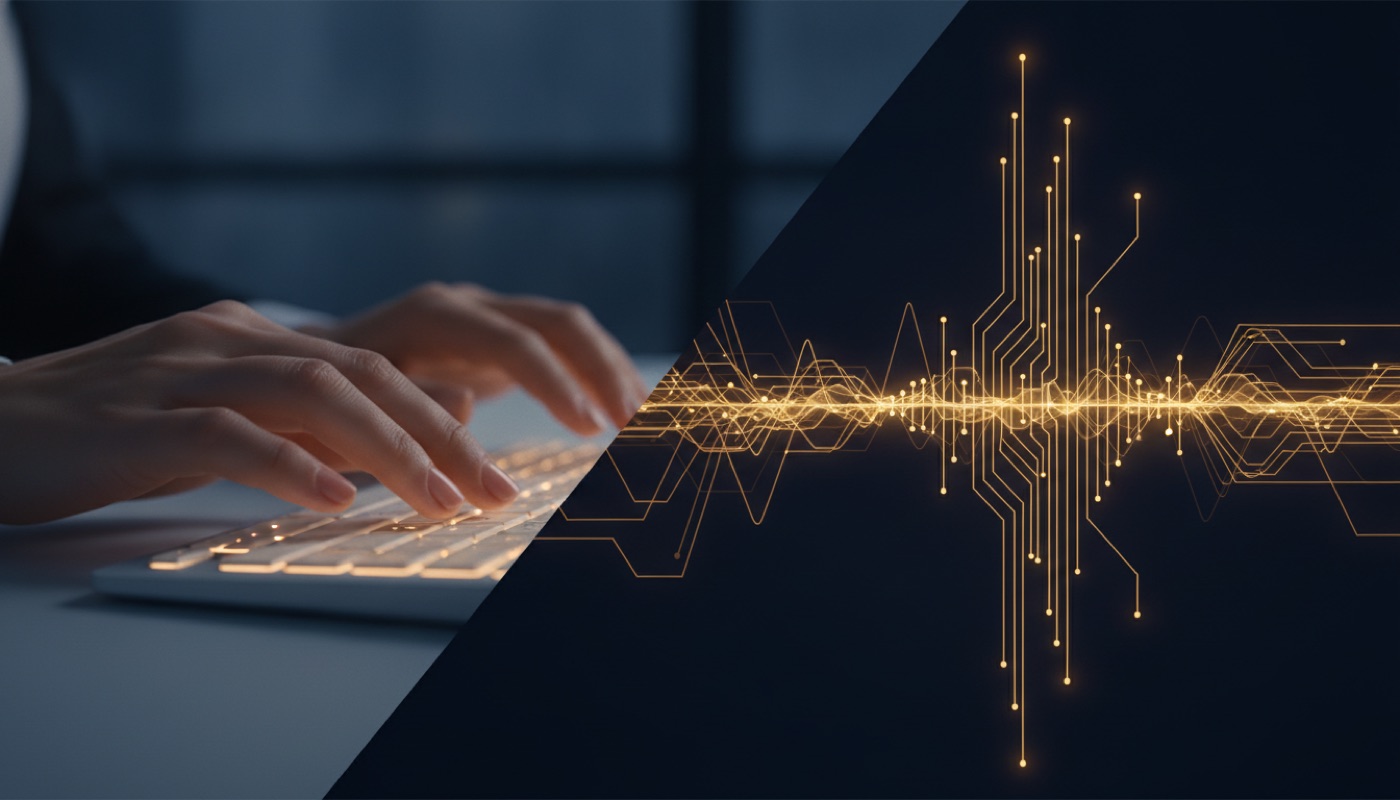
For a growing share of serious work, the right answer is sequence rather than selection. Let the machine draft in minutes. Then spend human attention only where it changes the outcome.
- Record well first. Good audio is the cheapest accuracy upgrade available. Close microphones, one speaker at a time, and a quiet room beat any software choice.
- Generate the draft. Ask for timestamps and speaker labels in the export, because both make the review pass much faster.
- Feed in a vocabulary list. Most services accept custom terms. Load the names, products and acronyms that appear in your material before you run the file.
- Review against the audio. Play back at a comfortable speed and stop at every name, number and technical term. Fix the confident substitutions first.
- Lock and label the final version. Note who checked it and when. A transcript that may be relied on later needs a visible owner.
Editing a decent draft is far quicker than typing from silence. The same budget of human attention then covers much more audio. Whatever tool you use, insist on timestamps in the export, since they let a reviewer jump straight to the doubtful second. That is the pattern behind our own TRANSCRIPT.YOU exports.
Choose by the cost of a mistake, not by the price of a minute.
Other crafts met automation long before transcription did, and the pattern repeats. The machine takes the repeatable labour and the person keeps the judgement. We look at that inheritance in what craftsmanship keeps when machines take the labour.
Five questions before you choose
If you take one tool from this article, make it this short check. Run the questions in order and stop when the answer is obvious.
- Stakes: would an undetected error be embarrassing, expensive or dangerous? The higher the cost, the more human review the work needs.
- Audio quality: clean, close-miked and one speaker at a time? AI will do well. Noisy, overlapping or far-field? Budget for human ears.
- Volume: above a few hours, pure human transcription stops being practical for most budgets. The question becomes where to spend review time.
- Deadline: if you need text today, the draft will be automatic. The only real choice left is how carefully it gets checked.
- Confidentiality: which do you trust further for this material, a vetted person under an NDA or a provider's automated pipeline?
Tip: Price the review, not just the transcription. Time one reviewer against one hour of AI draft, then compare that cost with a professional quote. The comparison decides whether a hybrid workflow beats hiring out.
The line between the two options will not stay where this article found it. Benchmark tracking such as Stanford HAI's AI Index records speech recognition improving year on year. The list of things machines transcribe badly keeps shrinking, though it has not emptied, and the hardest items have been on it a long time.
What does not move is the part of the work that was never really typing. Judgement about what was meant. Accountability for what the record says. The context to know which errors matter. The useful question is no longer human or machine. It is where, in a workflow that involves both, each one's precision belongs.
Key takeaways
- Decide by the cost of an error, not the price per minute: stakes first, logistics second.
- On clean audio, modern AI rivals professional accuracy; noise, crosstalk, accents and jargon reopen the gap fast.
- Humans err by lapse and flag their doubts, while machines err by confident substitution, which makes review essential.
- Legal, clinical, true-verbatim and hostile-audio work still favours professionals; meetings, drafts and archives favour AI.
- Test on ten minutes of your own typical audio before you commit to any service or price.