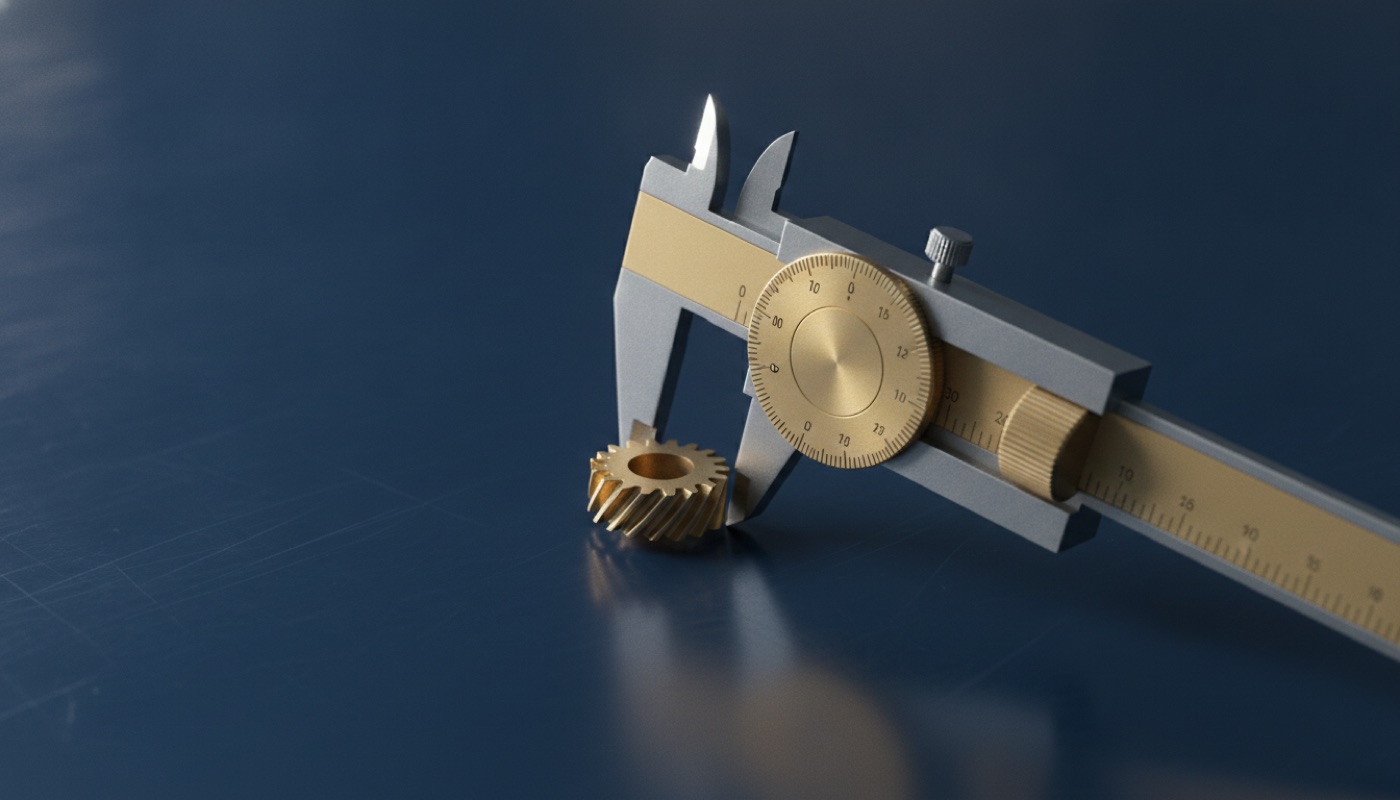
Short answer: Craftsmanship is a working relationship with a standard, not a preference for hand tools. AI makes competent work cheap, so competence alone no longer sets anyone apart. Watchmaking met the same shock from quartz in the 1970s. Its value moved up to judgment, verification, finishing and accountability. That is where your value moves next.
A quartz watch keeps time to within roughly 15 seconds a month. A mechanical watch certified by the COSC, the Swiss official chronometer testing institute, may run 4 seconds slow to 6 seconds fast each day. The cheap machine wins the measurable contest outright. Mechanical watches still sell, and buyers pay more for them than they did in 1970.
That result looks irrational until you see what moved. Accuracy stopped being the product and became the entry fee. Everything above that line was what people had been buying all along.
AI has just done the same thing to a far larger set of trades. Drafting, coding, summarising, translating and first-pass design are now instant and close to free. This article is about what rises above the line when that happens, and how to work up there deliberately.
What craftsmanship actually means
Craftsmanship sounds like nostalgia: leather aprons, hand tools, suspicion of anything with a plug. The working definition is stricter. The sociologist Richard Sennett, in his 2008 book The Craftsman, describes it as the desire to do a job well for its own sake.
Read that closely and it is a claim about standards, not materials. Nobody can want to do a job well without holding a picture of what well means. Craftsmanship is a relationship between a worker and a standard. Every practical habit follows from that one sentence.
The three parts of a standard
A standard that actually changes the work has three moving parts. Remove one and the other two stop functioning.
- A definition of done: a written, checkable description of acceptable output. Think of a tolerance in millimetres, a rate in seconds per day, or a transcript error rate.
- Trained perception: the ability to see the gap between that definition and the object in front of you. Most people call this taste, and it is built by repetition, not by opinion.
- The patience to close the gap: the willingness to redo the last ten per cent that no customer would ever have noticed.
Watchmaking shows all three at once. A finisher bevels the inside angle of a bridge by hand, a cut no machine can make cleanly. The part then sits under the dial, invisible for the life of the watch. The standard, not the audience, decides that the work gets done.
Why “handmade” is the wrong test
The Arts and Crafts movement of the late nineteenth century got one half of this right. Care does show in a finished object, and its absence shows too. It got the other half wrong by treating machines as the enemy.
Serious workshops today cut cases on CNC machines and shape hardened steel by spark erosion. They then hand-finish the surfaces where geometry alone is not enough. The test is never which tool touched the work. The test is whether a person held it against a standard before it left the bench. We follow that idea from lathes to source code in the philosophy of precision.
The quartz crisis was a rehearsal for this
On 25 December 1969, Seiko put the Astron on sale in Tokyo. It was the first quartz wristwatch sold to the public, and it kept time about a hundred times better than the mechanical watches beside it. Within ten years, quartz movements cost less than a meal.
The Swiss industry nearly vanished. Its workforce fell by more than half between 1970 and the mid-1980s, and long-established firms closed or merged. The measurable skill of four centuries had become a commodity part bought by the tray.
How value moved from accuracy to finishing
The recovery did not come from beating quartz, because nobody could. The industry conceded the number and repriced everything else. Buyers began paying for the architecture of the movement, for hand finishing, and for the judgment of a named workshop.
Two things made that credible rather than sentimental. The first was mechanism you could understand, which our walkthrough of how a wound mainspring becomes a measured second sets out stage by stage. The second was verification: chronometer testing, hallmarks, and the codified rules behind the Swiss Made label. Care stopped being a claim and became an audit.
Machines make adequate work abundant. Care refuses to become abundant, which is exactly why it holds its price.
AI raises the floor of work, not the ceiling
Be exact about what has changed. A large language model predicts likely text from patterns in its training data. That has lifted the floor dramatically: the laziest available draft is now fluent, grammatical and free.
The ceiling has not moved, because the ceiling is not built from fluency. It is built from decisions. Which of forty acceptable versions suits this reader. Which claim needs checking, and what should be cut. And when the honest answer is that the work is not ready.
| Task | What the machine now supplies | What has to stay yours |
|---|---|---|
| Written report | A fluent draft in seconds | The argument, the evidence, the cuts |
| Software | Boilerplate, tests, plausible fixes | Architecture, security review, the bug you own |
| Interface design | A dozen layouts on request | Knowing which one a tired user can operate |
| Meeting notes | A full transcript and a summary | Deciding what was actually agreed |
| Research | A fast survey of sources | Checking each claim against the source |
Fluency is not accuracy
A model writes with the same confidence whether its claims are true or invented. That failure has a name, and our guide to why chatbots make things up shows where the risk concentrates. Fluency is a style, not evidence.
So verification becomes the work rather than an afterthought. Speech recognition makes the point cleanly. A transcript can score a low word error rate and still misspell the one name that matters. That trade-off is examined in human versus AI transcription. The machine handles volume. A person handles consequence.
Tip: Before accepting generated work, write one sentence describing what would make it wrong. If you cannot write that sentence, you are not yet qualified to approve the output.
Four myths about craft and machines
Most arguments about craftsmanship stall on the same four misunderstandings. Each is easy to clear.
- Myth: craft means hand tools. Craft means a standard held by a person. A watchmaker with a CNC mill and a workshop with a laser cutter both qualify, provided someone inspects the result.
- Myth: craft means slow. Craft means unhurried at the point of judgment, not slow everywhere. Machines exist to buy that time back, and the great workshops have always used them.
- Myth: craft is a feeling. The craft that survives is written down as tolerances, checklists, review and acceptance tests. Mood cannot be taught, audited or handed to an apprentice.
- Myth: nobody notices. People rarely name what they are reacting to, yet they consistently prefer the cared-for version. The wider case for that sits on our design and craft topic page.
How to judge whether work was cared about
Care leaves fingerprints. Once you know where to look, a two-minute inspection tells you most of what you need.
Signals in a physical object
- Hidden surfaces: look at the parts nobody was supposed to see, such as a case back, a seam or the underside of a lug.
- Fit and action: a bezel that clicks without slop, and a crown that threads without hunting. Both report on tolerances measured in hundredths of a millimetre.
- Serviceability: objects made with care can be opened, cleaned and repaired rather than replaced when one component wears.
- Honest materials: the specification is stated plainly, such as 316L steel, grade 5 titanium or a sapphire crystal at 9 on the Mohs scale.
Signals in digital work
- Error and empty states: the screens nobody demos are the clearest evidence of who thought the whole job through.
- Accessibility: conformance with the W3C accessibility guidelines is codified care for users the author will never meet.
- Tested, not assumed: usability is measured with real people, as the Nielsen Norman Group has argued for decades.
- Defined limits: stated tolerances and acceptance criteria, the discipline described in tolerance and testing, are the digital equivalent of a gauge block.
Notice that every signal in both lists is checkable by someone other than the maker. That is not a coincidence. Standards travel; enthusiasm does not, which is the point of the quality standards collection.
A working method with AI in the loop
None of this argues for refusing the tools. It argues for a posture, and the posture can be stated as five habits.
- Own a standard the tool does not have. A model optimises for plausibility. You must hold a definition of done that is stricter than fluent.
- Inspect the material. A watchmaker never fits a component unexamined. Read every line you ship and check every claim you publish.
- Spend the saved hours on the ceiling. Reinvest the time in verification, restraint and finishing, or the tool has only made you faster at mediocrity.
- Sign the work. A name attached is how a standard gets enforced. Whatever the tool contributed, the judgment and the accountability are yours.
- Keep practising. Judgment is trained by doing. Delegate production freely, but never delegate the skill you are trusted for.
What to hand over, and what to keep
The division is easier than it sounds. Hand over work that is repetitive, reversible and cheap to check. Keep work that is irreversible, consequential or hard to verify later.
- Safe to delegate: boilerplate code, format conversion, first drafts, rough translation, file renaming and search across long documents.
- Delegate with review: summaries, data extraction, outlines and anything that will be read by someone outside your team.
- Keep yourself: the brief, the final cut, factual verification, ethical calls and anything that carries your name.
Tip: Measure the habit by how much of a draft survives your edit. If you keep only a quarter of an AI answer, the brief was too thin, not the model.
What craftsmanship costs, and where to spend it
Craft is not free, and pretending otherwise makes it easy to dismiss. It costs time at the end of a job, when everyone would rather ship. It costs the discomfort of saying that work is not ready.
So spend it deliberately. Not every task deserves a bevelled edge, and a shopping list needs no proofreading.
- Work that carries your name: anything a client, reader or colleague will attribute to you personally.
- Work others build on: shared code, a data model, a template that will be copied fifty times.
- Work that is expensive to undo: published claims, contracts, migrations and anything that reaches a customer.
Key takeaways
- Craft is a standard, not a material. It is the relationship between a worker and a checkable definition of done.
- Quartz is the precedent. When machines took accuracy, watchmaking moved its value to finishing, judgment and accountability, and prospered.
- AI lifted the floor only. The ceiling is made of decisions, verification and taste, and none of those got cheaper.
- Written-down care scales. Tolerances, review, accessibility rules and acceptance tests are how quality survives a deadline.
- Delegate production, keep judgment. Use the tool for volume, then inspect, cut and sign the result yourself.
Targa Watches was founded in Copenhagen in 2021 on that wager. Its seven collections are now stocked in Copenhagen and Seoul, and online at MaxUr.dk. The same conviction shapes a finished movement in the Targa collections and a piece of software written to be worth trusting. The age of AI will produce more work than any period in history. The work people keep will be the work someone cared about, and more of that argument waits in our Craft & Precision journal.