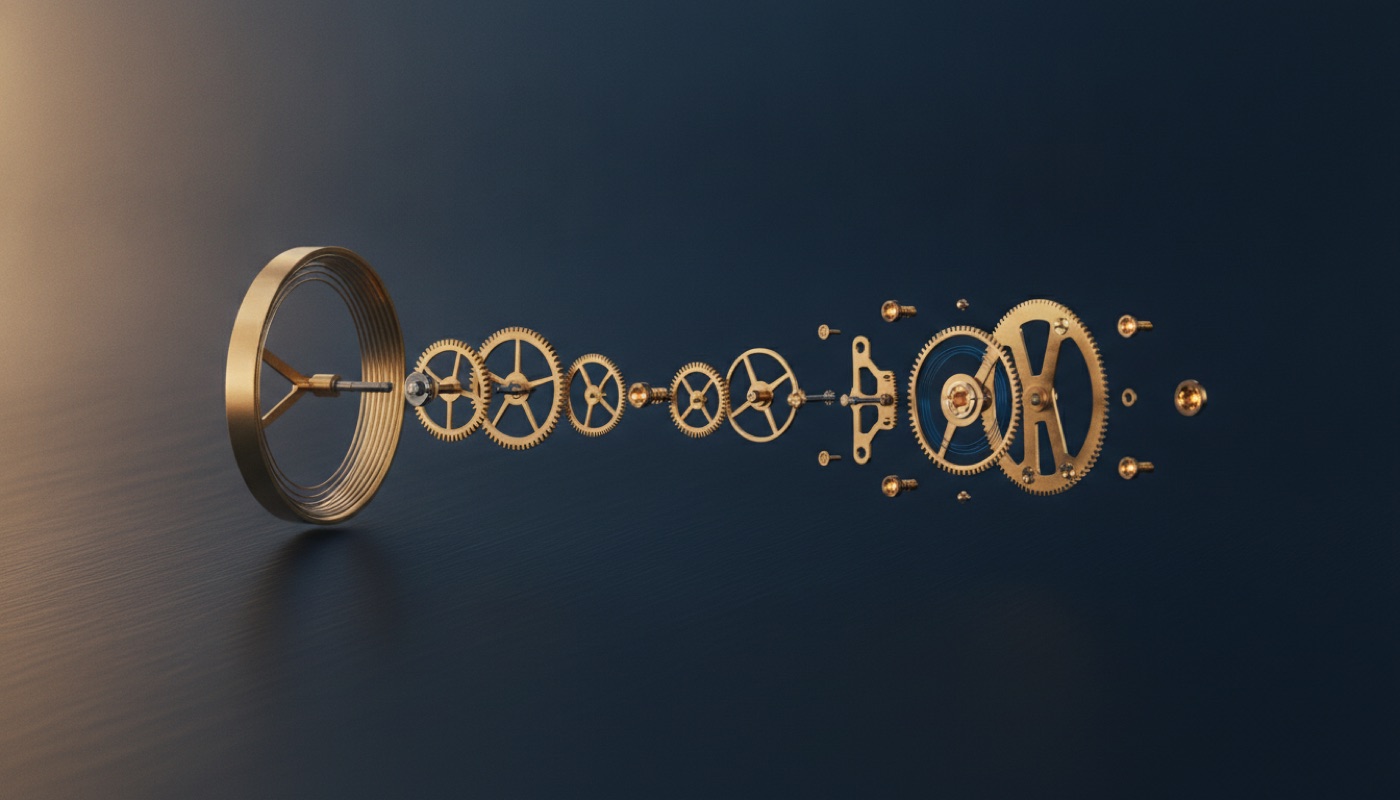
Short answer: A mechanical watch runs on a coiled mainspring. That energy travels through a gear train to the escapement, which releases it one tooth at a time. Each release pushes the balance wheel, an oscillator that swings at a fixed rate. Counting those swings is how the hands know where to point.
Coil a ribbon of hardened steel and it wants to let go all at once. A mechanical movement exists to stop that from happening. It rations the spring's energy into equal parcels, eight a second in most modern watches, for two or three days at a stretch. There is no battery, no circuit board and no software. There is only metal, geometry and friction that someone has learned to control.
The layout is remarkably standard. A watch costing a few hundred pounds and one costing a few hundred thousand follow the same five-stage plan. What separates them is finishing, materials and tolerance, not the basic plot. This guide follows the energy from the barrel to the hands. It also explains what each stage means for winding, accuracy and repair.
The five stages energy passes through
Every mechanical calibre — the trade word for one specific movement design — does the same five jobs in order. Learn the sequence and the rest of horology falls into place.
- Store. The mainspring holds days of energy inside a drum called the barrel.
- Transmit. The gear train carries that torque across the movement, trading force for speed.
- Release. The escapement lets the train advance one tooth at a time.
- Oscillate. The balance wheel and hairspring swing at a fixed rate and set the tempo.
- Display. More gearing turns counted swings into the sweep of the hour, minute and seconds hands.
A plain time-only movement does all of this with roughly 130 parts. Many are smaller than a grain of rice. Anything shown on the dial past hours, minutes and seconds is a complication. Our guide to what complications add to a base calibre picks up there, and the watch movements topic page holds the wider reading. Britannica's overview of the watch as a machine makes a useful companion reference.
The mainspring: days of power in a coiled ribbon
The mainspring is a long, thin ribbon of alloy coiled inside the barrel. Winding tightens the coil. The spring then spends the next few days relaxing, turning the barrel slowly as it unwinds. Modern springs use cobalt-nickel alloys such as Nivaflex. They resist fatigue far better than the carbon steel of the 1800s, which took a set and lost power over time.
How long one full wind lasts is the power reserve. Most current movements store 38 to 70 hours, and a growing number run for a week. Your crown reaches the spring through the keyless works, a small group of levers and a sliding pinion. Pull the crown out and those levers switch it from winding the spring to setting the hands.
Hand-wound and automatic: one spring, two ways to fill it
A hand-wound watch is filled at the crown. Resistance builds as you turn, then the crown comes to a firm stop. That stop is the signal to leave it alone. An automatic adds a weighted rotor that swings as your wrist moves and winds the spring through reduction gears.
Automatics cannot be overwound. A slipping clutch called the bridle lets a full spring slide harmlessly inside the barrel wall. If an automatic has stopped, hand-wind roughly 30 turns first, then set the hands. A quiet day at a desk often fails to keep one topped up.
Why the spring's push is never even
A spring pushes hardest when fully wound and weakest when nearly flat. That falling torque is the central problem of the whole machine. Early makers fought it with a fusee and chain, a cone-shaped pulley that evened out the pull.
Modern makers instead build an escapement and balance that tolerate the change. A few also fit a remontoir, which re-tensions a small secondary spring at fixed intervals. The same architecture drove pocket watches long before it shrank, a shift traced in our account of how the wristwatch took over.
Tip: Wind a hand-wound watch at the same time each morning. Your waking hours then run on the strong, even part of the mainspring's curve, where the rate is at its most stable.
The gear train: slow torque in, fast motion out
The barrel turns roughly once every six hours. That slow, strong rotation enters the gear train, a chain of brass wheels driving hardened steel pinions. Each pair trades torque for speed. The centre wheel turns once an hour and drives the minute hand. The fourth wheel turns once a minute and usually carries the seconds hand.
The hour hand gets its own reduction, called the motion works. A cannon pinion, minute wheel and hour wheel divide the minute hand's rotation by twelve. That gearing is why one crown sets both hands together, and why they never drift out of step. Wheel teeth are cut to rolling profiles that keep contact smooth and losses low.
What the jewels in a movement actually do
Watch jewels are synthetic rubies, not decoration. Ruby and sapphire are both corundum, a mineral ranked 9 on the Mohs scale and beaten only by diamond. Auguste Verneuil's flame-fusion process, published in 1902, made lab-grown corundum cheap enough for every workshop. The same crystal reappears over the dial, as our guide to why watch glass is grown from corundum explains.
Each jewel is drilled and polished into a tiny cupped bearing. It holds a microscopic ring of oil and lets a steel pivot spin for decades with almost no wear. Seventeen jewels is the classic full complement for a time-only calibre. Automatics normally carry 21 to 25. A higher count signals extra mechanisms, not extra value.
The escapement: where the ticking comes from
The escapement is the gatekeeper between raw power and measured time. Almost every mechanical watch built in the past century uses the Swiss lever escapement, refined from the lever design Thomas Mudge produced around 1755. A forked lever tipped with two ruby pallet stones rocks back and forth. It locks a tooth of the escape wheel, releases it, then locks the next one.
Each release does two things at once. The train advances by exactly one tooth, and a small push called the impulse travels through the lever to the balance. The tick you hear is those pallet stones landing. Britannica's entry on the escapement traces the idea back through pendulum clocks to medieval tower clocks.
A mechanical watch does not so much measure time as spend it, paying out stored energy in equal instalments, eight to a second, for days on end.
How fast does a movement beat?
Beat rate is quoted in vibrations per hour, or vph. Two vibrations make one complete swing. So 28,800 vph equals 4 Hz, or eight audible ticks every second.
Faster rates recover better from knocks and sweep the seconds hand more smoothly. Slower rates spend the mainspring more frugally and wear their parts less. Neither choice is simply better, which is why both are still in production.
The balance wheel and hairspring: the real timekeeper
Everything so far only moves energy around. The balance assembly is what turns it into time. A weighted wheel sits on a fine staff and couples to a spiral hairspring. The escapement pushes it, the spring pulls it back, and it swings through again at a near-constant interval.
That property is isochronism: each swing takes almost the same time however hard it was pushed. Christiaan Huygens applied a spiral spring to a balance in 1675, and portable timekeeping has rested on the idea ever since. A healthy balance swings roughly 270 to 315 degrees each way at full wind. Watchmakers call that figure the amplitude.
Materials matter here more than anywhere else in the watch. Charles Édouard Guillaume won the 1920 Nobel Prize in Physics for Invar and Elinvar, alloys that barely change with temperature. Their descendant, Nivarox, remains the standard hairspring alloy. Silicon hairsprings go further, because silicon is non-magnetic and needs no oil. Shock settings such as Incabloc, introduced in the 1930s, let balance pivots spring aside on impact instead of snapping.
How a watchmaker adjusts the rate
Rate is tuned at the oscillator, never at the hands. A regulator arm shortens or lengthens the active part of the hairspring, which speeds the balance up or slows it down. Free-sprung movements drop the regulator and use tiny timing weights on the balance rim instead. That design holds its rate better after a knock.
The tool of record is a timing machine, or timegrapher. It listens to the ticks and reports three numbers: daily rate in seconds, amplitude in degrees and beat error in milliseconds. A beat error under 0.5 ms means the two half-swings are evenly spaced. Good movements are adjusted in five or six positions, because gravity loads the balance differently in each one.
How accurate should a mechanical watch be?
Accuracy has published yardsticks, so nobody has to guess. The table sets the main ones side by side.
| Standard | Allowed daily rate | How it is tested |
|---|---|---|
| Uncertified movement | Often −20 to +20 seconds | Factory regulation, one or two positions |
| COSC chronometer (ISO 3159) | −4 to +6 seconds | 15 days, 5 positions, 3 temperatures |
| METAS Master Chronometer | 0 to +5 seconds | Cased watch, plus exposure to 15,000 gauss |
| Quartz wristwatch | About ±15 seconds a month | 32,768 Hz crystal, trimmed at the factory |
Only movements that pass independent testing may be sold as chronometers. Switzerland's Contrôle Officiel Suisse des Chronomètres runs that test to ISO 3159 across 15 days. Quartz still wins on raw numbers. A mechanical chronometer reaches its figure with springs and levers alone. That is a different order of achievement, and part of why the Swiss Made label carries weight.
Why magnetism is the usual culprit
Magnetism causes most sudden, dramatic errors. A magnetised hairspring pulls its own coils into contact, so the spring behaves as though it had been shortened and the balance swings faster. Gains of several minutes a day follow. ISO 764 sets the antimagnetic benchmark at 4,800 A/m, roughly 60 gauss, with the rate holding within 30 seconds a day. Silicon and Nivarox-family springs raise that ceiling considerably, and a bench demagnetiser reverses the fault in seconds.
What common symptoms are telling you
Most complaints map onto a short list of causes. Treat these as a first read rather than a repair manual.
- Gaining minutes a day. Almost always magnetism. Demagnetising is quick and cheap.
- Stops overnight although you wore it. A still day did not move the rotor enough. Hand-wind 30 turns.
- Losing time gradually over years. Oils have thickened and amplitude has dropped. Book a service.
- Crown spins with no resistance. Stop winding at once. The mainspring or keyless works may have failed.
- Date flips at noon. The hands are set twelve hours out. Advance them a full turn and reset.
- Rattling when shaken. A loose rotor or a broken part. Keep the watch still and take it in.
Habits that keep the mechanism healthy
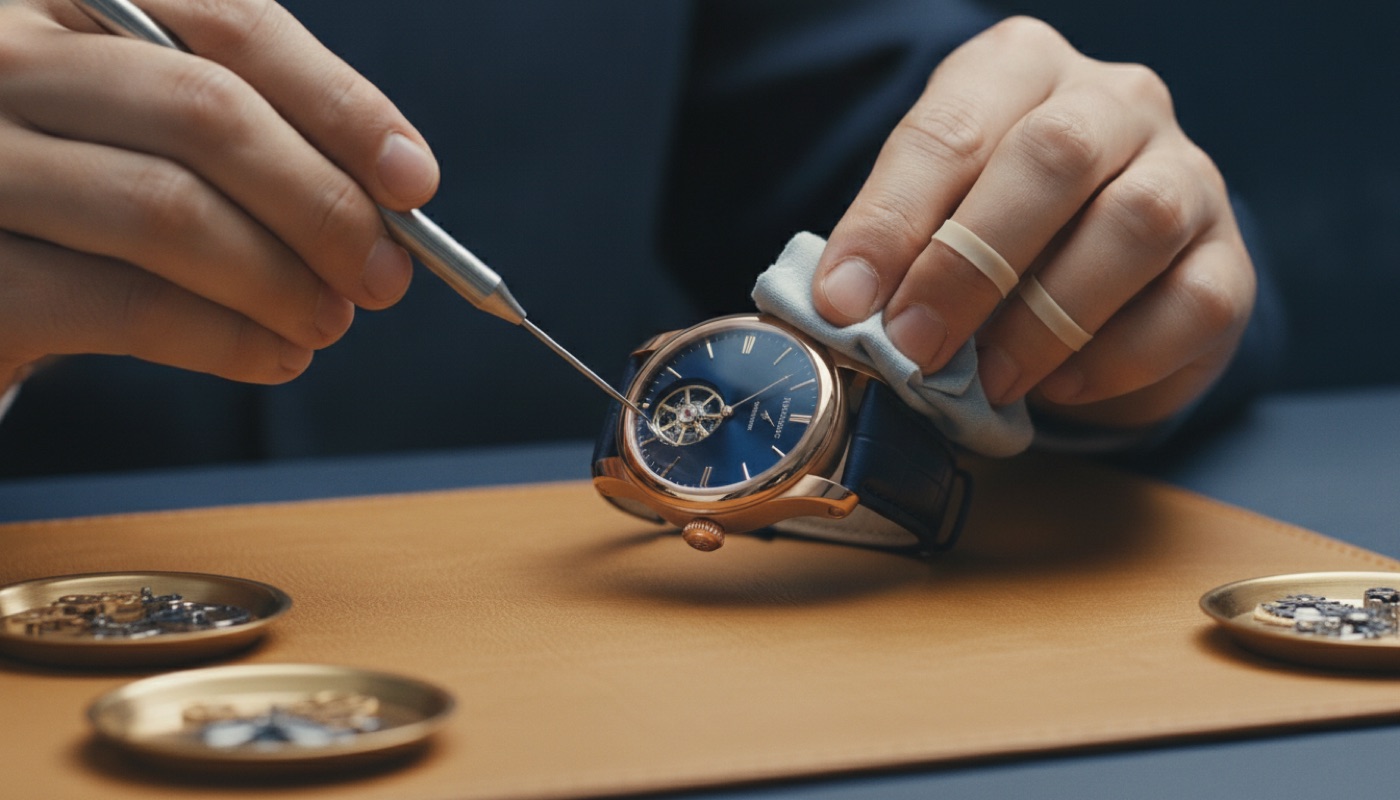
A movement asks for very little, but it asks consistently. Plan on a full strip-down somewhere between five and ten years, depending on the calibre and how hard you wear it. Lubricants oxidise and thicken long before parts wear out. A service cleans, re-oils and re-regulates the movement, and our account of what happens on a watchmaker's bench covers the routine between visits.
Resting position is a free tuning tool. Gravity loads the balance differently in each orientation, so a watch that gains on the wrist may settle when parked dial-up or crown-down. Try a week in each position and keep the one that suits you. Leave the date alone from mid-evening until the small hours, while the calendar wheels are already meshed.
Knowing the mechanism also makes specification sheets readable. Power reserve, beat rate, jewel count and positions adjusted stop being marketing words. They become measurements you can compare across the Targa watch collections or any other maker's catalogue. That is the same trick tolerance and testing perform in engineering.
Tip: Keep a watch at least 10 cm away from speakers, magnetic phone mounts and tablet covers. Most modern magnetic faults start on a desk, not in a workshop.
Key takeaways
- Every movement follows one path: mainspring, gear train, escapement, balance, hands.
- Power reserve is simply the mainspring's capacity, usually 38 to 70 hours.
- The balance and hairspring keep the time; the escapement only feeds them energy.
- Jewels are synthetic ruby bearings, and 17 is the classic full complement.
- Automatics cannot be overwound, while hand-wound watches stop firmly at full wind.
None of this knowledge is needed to enjoy a watch. It does make you a better custodian, and it explains why the craft still holds attention in an age of networked, atomic time. That argument runs through the philosophy of precision and the wider Watches & Horology journal. Meanwhile the mainspring on your wrist is losing its argument with physics exactly as designed, a few degrees of uncoiling for every hour it keeps.