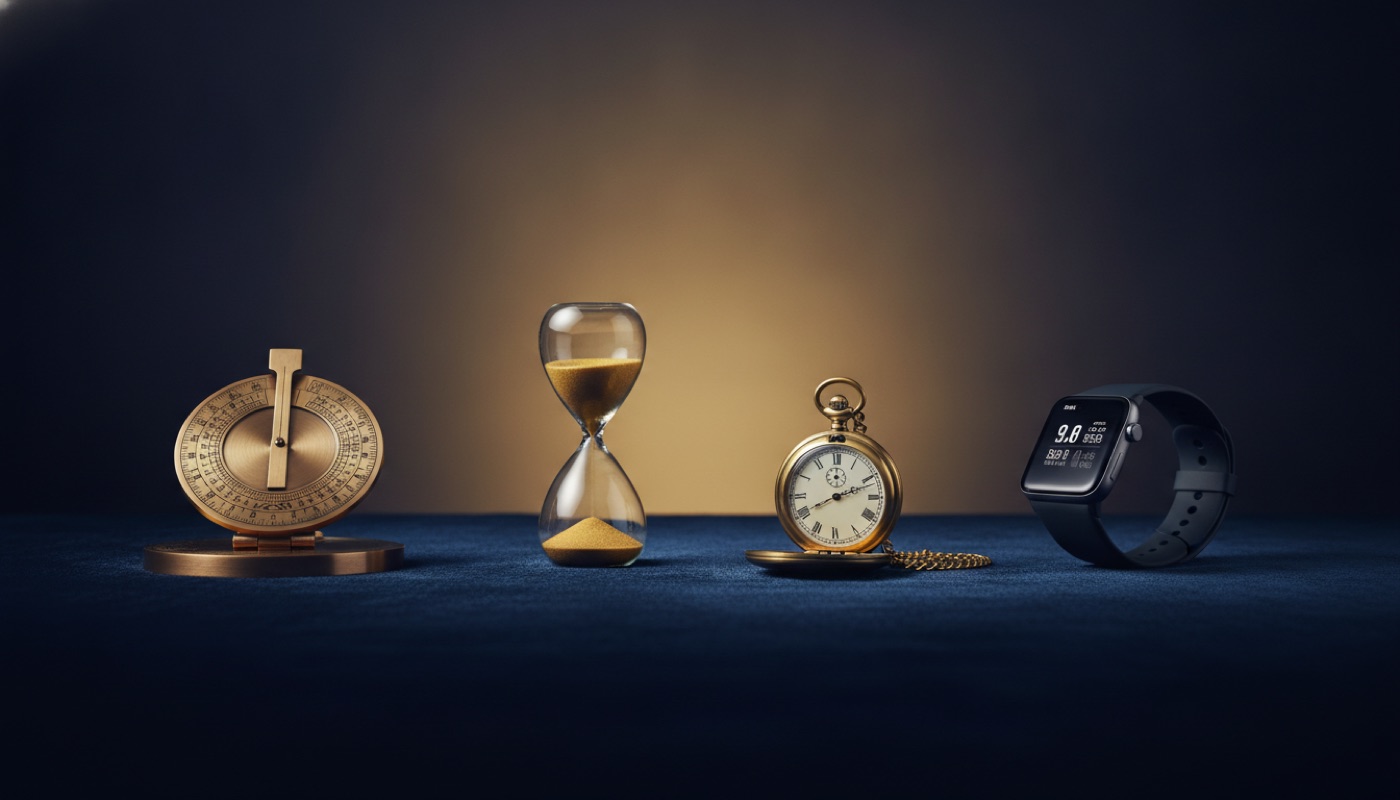
Short answer: Every clock measures motion, not time. A timekeeper needs a steady oscillator, a counter and a display. Shadows gave way to falling water, then to gears, then to the pendulum of 1656. Quartz crystals at 32,768 hertz followed, and then the caesium atom, which has defined the second since 1967.
A stick pushed upright into the ground was the first clock. Its shadow moved because the Earth turned, and someone noticed that the movement was regular enough to divide. Every timekeeper since has done the same job with a steadier moving part.
No instrument measures time directly. We find something that repeats, count the repetitions, and agree to call the count an hour or a second. The search for a better thing to count has run for at least four thousand years.
The gains were never academic. Better clocks made fixed prayer, court procedure, ocean navigation, railway timetables and satellite positioning possible. Each of those needed a smaller error than the last, a thread our history of timekeeping collection follows into modern watchmaking.
What a clock actually is
The instruments in this history look nothing alike. A shadow on stone, a dripping pot and a caesium beam share no parts. Underneath, every one of them is built the same way.
Three parts, in every clock ever built
Strip any timekeeper and three components remain.
- An oscillator: something that repeats at a steady rate, such as a swinging pendulum or a vibrating crystal.
- A counter: a mechanism that tallies the repetitions, such as a gear train or a digital circuit.
- A display: hands, engraved lines, a screen or a chime that turns the tally into a reading.
A sundial uses the Earth itself as its oscillator, one turn a day, with engraved lines as the counter. A wristwatch uses a balance wheel, a gear train and two hands. A caesium standard uses an atom, an electronic counter and a digital output. The architecture never changes.
Why stability matters more than accuracy
Accuracy is how close a clock sits to true time right now. Stability is how well it holds its own rate from one day to the next. The two are different, and the second is worth more.
A clock that loses exactly ten seconds every day is easy to correct. A clock that loses ten seconds today and gains eight tomorrow cannot be rescued by any adjustment. Every leap in this history came from a steadier oscillator rather than a cleverer dial. Modern manufacturing rests on the same distinction, as our piece on tolerance and testing in precision engineering describes.
No clock has ever measured time. Each one counts something that repeats, and asks you to trust the count.
Where the 24-hour day and the 60-minute hour came from
Egyptian astronomers divided daylight into twelve parts. They tracked the night by the rising of twelve star groups called decans. Twelve plus twelve produced the 24-hour day, which was in use by around 1500 BCE.
Those hours were seasonal rather than equal. A twelfth of winter daylight is shorter than a twelfth of summer daylight, so an hour changed length through the year. Equal hours became normal only when mechanical clocks made them convenient.
Sixty came from Babylon. Babylonian mathematics used a sexagesimal system, or base sixty, which divides evenly by 2, 3, 4, 5, 6, 10, 12, 15, 20 and 30. Greek astronomers, Hipparchus and Ptolemy among them, used those fractions when they cut the hour into sixty minutes and the minute into sixty seconds.
The units on your wrist are therefore a merger. Egyptian daylight counting, Babylonian arithmetic and Greek astronomy were all settled long before any gear turned. Clockmakers inherited the conventions and had to build machines that fitted them.
Before gears: sun, water, sand and fire
For roughly three thousand years, measuring time meant watching something natural move. Each method solved one problem and created another.
Shadow clocks came first, then the sundial, which Greek and Roman engineers refined for two millennia. The sundial remained the reference against which other clocks were set until the eighteenth century. Its faults were absolute: no reading at night, none under cloud, and hours that stretched with the seasons.
The clepsydra: time that ran in the dark
Water covered the night. The clepsydra was a vessel that drained through a small hole past marked levels, and Egyptian temples used them by about 1400 BCE. Athenian courts used water clocks to ration the length of speeches.
Flow, however, is not constant. A full vessel drains faster than a nearly empty one, because pressure falls as the water level drops. Ctesibius of Alexandria answered with a constant-head design that held the pressure steady, then added floats and pointers to read it.
The form reached its peak in China. In 1092 CE the official Su Song completed an astronomical clock tower over ten metres tall. A water wheel drove it, advancing one scoop at a time. That controlled, step-by-step release was an escapement in everything but name.
Sand, wax and incense
Simpler devices filled the gaps that water left.
- Candle clocks: a marked candle burned down at a roughly known rate, giving elapsed hours indoors and after dark.
- Incense clocks: used in China, these burned a trail of scented powder, sometimes changing scent to mark each interval.
- The hourglass: arrived in the fourteenth century with one unbeatable advantage. It worked aboard a moving ship.
That last point mattered more than it sounds. Sailors timed a knotted line paid out over the stern against a small sand glass. That is why a ship's speed is still given in knots.
The mechanical era: bells, mainsprings and the pendulum
The verge escapement and the first public clocks
In the late thirteenth century, European craftsmen built the first fully mechanical clocks. A falling weight supplied the power. A verge escapement with a swinging foliot bar released that power in small, repeated steps, which is the trick that makes a clock a clock.
The earliest examples had neither dial nor hands. They rang bells to summon monks and townspeople, and the word clock descends from clocca, medieval Latin for bell. Britannica's history of the clock traces how quickly they spread across Europe. The surviving mechanism at Salisbury Cathedral, usually dated to about 1386, belongs to this first generation.
Accuracy was poor by any later standard, at around fifteen minutes a day. It hardly mattered. A machine that ran through the night in any weather was a new kind of object, and every clock was reset from a sundial anyway.
The fifteenth century added the mainspring, a coiled ribbon of hardened steel that replaced the falling weight. Clocks became portable, then domestic, then wearable. Stored power, a geared train, an escapement and a display: that architecture is still in production. Our guide to how a mechanical watch movement works follows it part by part.
Huygens, the pendulum and a hundredfold leap
Galileo Galilei observed that a pendulum takes nearly the same time to swing whether its arc is wide or narrow. Christiaan Huygens turned that observation into a working clock in 1656. Error fell from roughly fifteen minutes a day to roughly fifteen seconds.
Nothing else in this history improved so much in a single step. The gain came from replacing a crude oscillator with a good one, while the counting mechanism stayed much as it was. In 1675 the balance spring did the same favour for portable watches, and its invention was disputed between Huygens and Robert Hooke.
Longitude, railways and the invention of standard time
Finding longitude at sea is a timekeeping problem. The Earth turns fifteen degrees of longitude every hour. A navigator who knows the time at a reference port can turn a time difference into a distance east or west.
- Carry a reference clock: set it to the home port's time and never adjust it, whatever the voyage does to it.
- Find local noon: measure the sun at its highest point with a sextant.
- Take the difference: each hour of difference equals fifteen degrees of longitude.
The method was understood long before any clock could survive months of salt, damp and pitching decks. Britain's Longitude Act of 1714 offered up to twenty thousand pounds for a working solution. John Harrison, a Yorkshire carpenter, spent most of his life earning it. His fourth timekeeper, H4, lost about five seconds on an eighty-one-day voyage to Jamaica in 1761.
The Royal Observatory at Greenwich, founded in 1675, attacked the same problem from the astronomical side. In 1884 the International Meridian Conference adopted its meridian as zero degrees longitude.
On land the pressure came from railways. Every town kept its own solar time, which made a national timetable confusing and occasionally dangerous. British railways ran on London time from the 1840s, distributed by telegraph and by dropping time balls at fixed hours.
Standard time is worth naming for what it is: an administrative invention barely two centuries old. Agreeing a shared unit is a different act from measuring one, and both are needed. Our article on what Swiss Made teaches about quality standards takes that idea further.
Marine chronometers meanwhile grew smaller decade by decade. They moved from the binnacle to the pocket and finally to the wrist, a change told in our brief history of the wristwatch.
Quartz, caesium and the second we use today
In 1927, Warren Marrison and J. W. Horton built the first quartz clock at Bell Telephone Laboratories. A quartz crystal flexes when a voltage is applied and vibrates at a rate fixed by its cut and size. It has no gear teeth to wear and no oil to thicken.
Watch crystals are cut as tiny tuning forks running at 32,768 hertz. That number is two to the fifteenth power, so a chain of simple dividing circuits halves it down to one pulse per second. Seiko's Astron of December 1969 was the first quartz wristwatch, and it kept time to seconds per month rather than seconds per day.
The steadiest oscillator known sits inside the atom. In 1955, Louis Essen and Jack Parry ran the first practical caesium clock at Britain's National Physical Laboratory. In 1967 the second itself was redefined as 9,192,631,770 periods of the radiation from a caesium-133 transition.
NIST tells that arc in detail in A Walk Through Time. The practical result is that the best caesium fountain clocks drift by roughly one second in a hundred million years.
Civil time is now a collective product. Coordinated Universal Time, or UTC, is computed by the International Bureau of Weights and Measures from hundreds of atomic clocks in national laboratories. Leap seconds keep it aligned with the Earth's slightly irregular rotation, and metrologists have agreed to retire them by 2035.
Satellite navigation shows why the extra decimals earn their keep. A receiver fixes your position by comparing signal arrival times from atomic clocks in orbit. Light travels about three hundred metres in a microsecond, so a clock error of one microsecond becomes a position error of three hundred metres.
Four thousand years of timekeepers, side by side
Set the instruments in one table and the pattern is unmistakable. Counters and displays changed slowly. The oscillator changed everything.
| Timekeeper | What oscillates | In use from | Typical error |
|---|---|---|---|
| Sundial | Earth's rotation, read as a shadow | c. 1500 BCE | Minutes, and nothing after dark |
| Water clock | A regulated flow | c. 1400 BCE | Tens of minutes a day |
| Verge-and-foliot clock | An oscillating foliot bar | c. 1300 CE | About 15 minutes a day |
| Pendulum clock | A swinging pendulum | 1656 | About 15 seconds a day |
| Marine chronometer | Balance wheel and spring | 1760s | Under a second a day |
| Quartz wristwatch | A crystal at 32,768 Hz | 1969 | Seconds per month |
| Caesium fountain | Caesium atoms near 9.19 GHz | 1990s | A second in ~100 million years |
| Optical clock | Strontium or ytterbium atoms | Laboratories today | Under a second in billions of years |
Tip: When you compare clocks across eras, compare error per day rather than headline claims. It is the one measure that works equally well for a sundial, a pendulum and an atomic standard.
Stating error honestly is a skill in itself, and it reaches well beyond horology. Any field with a shared measure needs an agreed way to report how wrong it can be. Speech systems publish word error rate for exactly that reason. Our explainer on what word error rate really means makes the parallel plain.
The project is not finished. Optical clocks count the far faster oscillations of atoms such as strontium and ytterbium. The best of them would neither gain nor lose a second over billions of years. Metrologists expect the second to be redefined around them in the coming decades.
Key takeaways
- Every clock counts motion. A steady oscillator, a counter and a display are all any timekeeper has ever had.
- Your day is Egyptian, your hour is Babylonian. Twelve daylight divisions and base-sixty arithmetic fixed the units before machines existed.
- 1656 was the biggest single leap. Huygens' pendulum cut daily error from about fifteen minutes to about fifteen seconds.
- Longitude made precision urgent. Harrison's H4 lost about five seconds across an eighty-one-day Atlantic voyage.
- The second is now atomic. Since 1967 it has been 9,192,631,770 caesium-133 oscillations, and UTC averages hundreds of such clocks.
Mechanical watches lost the accuracy argument in 1969 and kept their audience anyway. A balance wheel beating eight times a second is a working museum of this history. The dials and calendars built on top of it are catalogued in our guide to watch complications.
Every device here was somebody's best answer to one question: what repeats reliably enough to trust? The question has outlived all of its answers so far. Why the craft of answering it still matters is the subject of the philosophy of precision, and of the wider Craft & Precision journal.