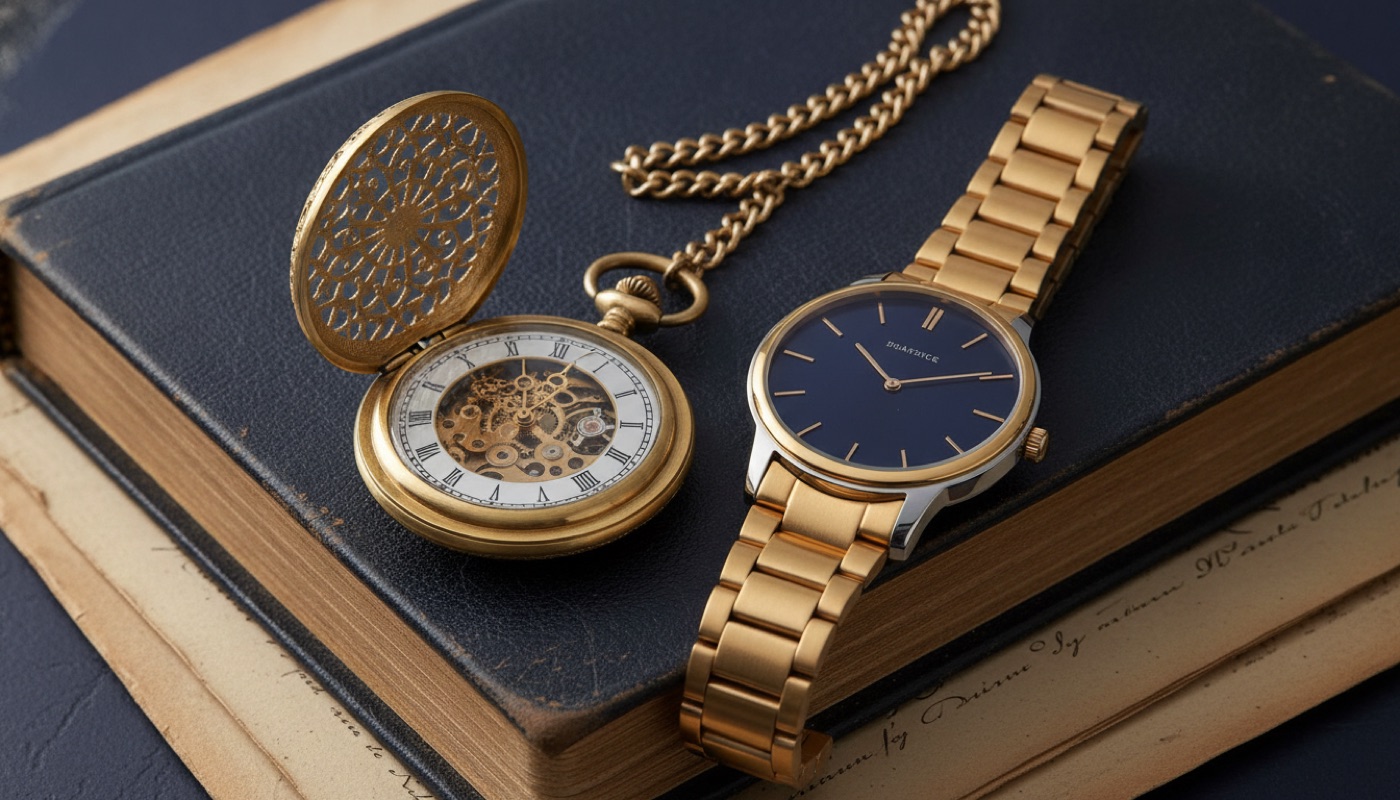
Short answer: The wristwatch began as women's jewellery. Abraham-Louis Breguet built the first documented example in 1810 for Caroline Murat, Queen of Naples. Soldiers made the form practical, and the First World War made it normal for men. Quartz nearly killed mechanical watchmaking after 1969, and craft brought it back.
The wristwatch spent its first hundred years being underestimated. It arrived as jewellery for royal women. Men called it a passing fashion and stayed loyal to the pocket. It became standard equipment only when war made the pocket watch impractical. Today it sits on hundreds of millions of wrists, in an age when every phone keeps better time.
The story has an unusual shape. Most inventions begin as tools and end as ornaments. The wristwatch travelled the other way. It began as decoration, hardened into an instrument, then softened into an object of craft once electronics made its original job trivial.
Before the wrist: four centuries in the pocket
Portable timekeeping starts in the early sixteenth century. Mainsprings became small enough to carry, and the clock finally left the wall. What followed was four hundred years of the pocket watch, and every habit of the wristwatch was formed in that period. Our history of timekeeping topic page picks up everything that came before.
Peter Henlein and the first portable watches
The Nuremberg locksmith Peter Henlein is usually credited with the first watches, around 1510. They were drum-shaped brass boxes worn on a chain or a cord. Most had a single hour hand and lost time by the hour, not the minute. Owners bought them as jewellery and status objects, not instruments.
Precision arrived in the 1670s with the balance spring, developed from the work of Christiaan Huygens. A spiral spring gave the balance wheel a natural rhythm, in the way a pendulum gives a clock one. Errors dropped from hours a day to minutes a day. Only then did it become worthwhile to print a minute hand on a dial.
How railways made accurate time a public duty
Two pressures pushed watchmaking towards real precision. At sea, finding longitude required a clock that kept time on a rolling ship. John Harrison solved it with his marine chronometers in the 1760s, and his methods filtered slowly into ordinary watchmaking. That thread is picked up in our short history of measuring time.
On land, the railways did the rest. Timetables turned shared time into a matter of public safety. Britain adopted railway time in the 1840s, and American railroads adopted standard time zones in 1883. After a fatal collision in Ohio in 1891, American railroads set published rules for the watches their staff carried. A watch now had to meet a written specification, an idea explored further in how an origin label became a quality rule.
By 1900 the pocket watch was a mature, mass-produced precision instrument. It was also, without knowing it, at the end of its reign.
The first wristwatches were made for women
The wrist arrived long before the argument was settled. For most of the nineteenth century a watch strapped to the arm was understood as a bracelet with a dial. Its buyers were women of means.
Breguet's commission for the Queen of Naples
The first documented wristwatch was a special order. In 1810 Abraham-Louis Breguet accepted a commission from Caroline Murat, Queen of Naples and sister of Napoleon. He built an exceptionally thin oval repeating watch, mounted on a wristlet woven from hair and gold thread. It was delivered in 1812.
In 1868 Patek Philippe made a bracelet watch for Countess Koscowicz of Hungary. It is generally treated as the first wristwatch offered for sale rather than made to order. In both cases the wearer was a woman, and for decades that settled the question. Wristwatches were bracelets that happened to tell the time, and no serious man would wear one.
Santos-Dumont asks Cartier for a solution
Soldiers dissented first. Officers in the colonial campaigns of the 1880s and 1890s strapped small pocket watches to their wrists with leather cups. During the Boer War the practice spread quickly, because coordinated movement under fire left no hand free for a waistcoat.
Aviation supplied the second push. In 1904 the Brazilian aviator Alberto Santos-Dumont complained to his friend Louis Cartier that he could not reach a pocket watch in flight. Cartier designed a flat, square-cased watch on a leather strap. The Cartier Santos reached the public in 1911, as the first wristwatch conceived for men as working equipment.
A few businessmen saw the direction of travel. Hans Wilsdorf founded his watch firm in London in 1905 and registered the Rolex name in 1908. He bet the company on the unfashionable idea that small watches could be accurate. In 1914 Kew Observatory awarded a Class A precision certificate to a Rolex wristwatch, a grade previously reserved for marine chronometers. That certificate did as much for the wristwatch as any battlefield.
The war that moved the watch from pocket to wrist
The First World War ended the argument. Trench warfare ran on synchronised time. A creeping artillery barrage lifted at a fixed minute, and infantry advanced behind it on the same schedule. Nobody could fumble in a waistcoat while holding a rifle. Officers bought wristwatches by the crate, and the trade name that stuck was the trench watch.
These were transitional objects, and their features solved trench problems directly.
- Wire lugs soldered to the case. Pocket-watch cases were converted with soldered loops for a leather strap.
- Shrapnel guards. Pierced metal grilles protected fragile glass crystals from splinters and knocks.
- Luminous dials. Radium paint made the hands readable at night. Its dangers were understood only in the 1920s, after the poisoning of the dial painters known as the Radium Girls.
- Bold enamel dials. Large Arabic numerals and a railway minute track kept the time readable in poor light.
The men who came home kept their watches, and the meaning of the object flipped. A wristwatch was no longer a feminine ornament. It marked someone who had been somewhere. By the 1930s wristwatches outsold pocket watches by a wide margin, and the industry rearranged itself around the change.
Necessity put the watch on the wrist. Craft is what has kept it there.
That rearrangement was technical as much as commercial. Case makers learned to build small, sealed, shock-resistant housings. Dial makers learned legibility under stress. Movement makers set about squeezing pocket-watch reliability into a fraction of the space. Miniaturisation became the central problem of watchmaking for the next fifty years.
The decades that built the modern watch
The answer to that problem, over forty years, was almost everything. A watch on a wrist gets knocked, splashed, magnetised and carried up mountains. Each hazard produced an invention, and most of them are still in use.
| Year | Breakthrough | Why it mattered |
|---|---|---|
| 1926 | Rolex Oyster case | The first commercially successful sealed case, with a screw-down crown and caseback |
| 1931 | Rotor self-winding | A weight turning through 360 degrees wound the mainspring from ordinary arm movement |
| 1953 | Blancpain Fifty Fathoms and Rolex Submariner | Established the rotating-bezel dive watch, the most copied design in horology |
| 1957 | Hamilton Ventura | The first electric wristwatch, replacing the mainspring with a battery |
| 1960 | Bulova Accutron | A tuning fork vibrating at 360 hertz beat any balance wheel for accuracy |
| 1969 | Automatic chronograph | Zenith, Seiko and the Heuer-Breitling consortium reached market within months of each other |
From sealed cases to self-winding
Two of those entries changed daily ownership more than the rest. The Oyster case of 1926 made a watch survivable in rain, sinks and swimming pools. Mercedes Gleitze wore one through a long Channel swim in 1927, and the marketing wrote itself. Modern sealing still follows that template, as we set out in why a depth marking is really a pressure test.
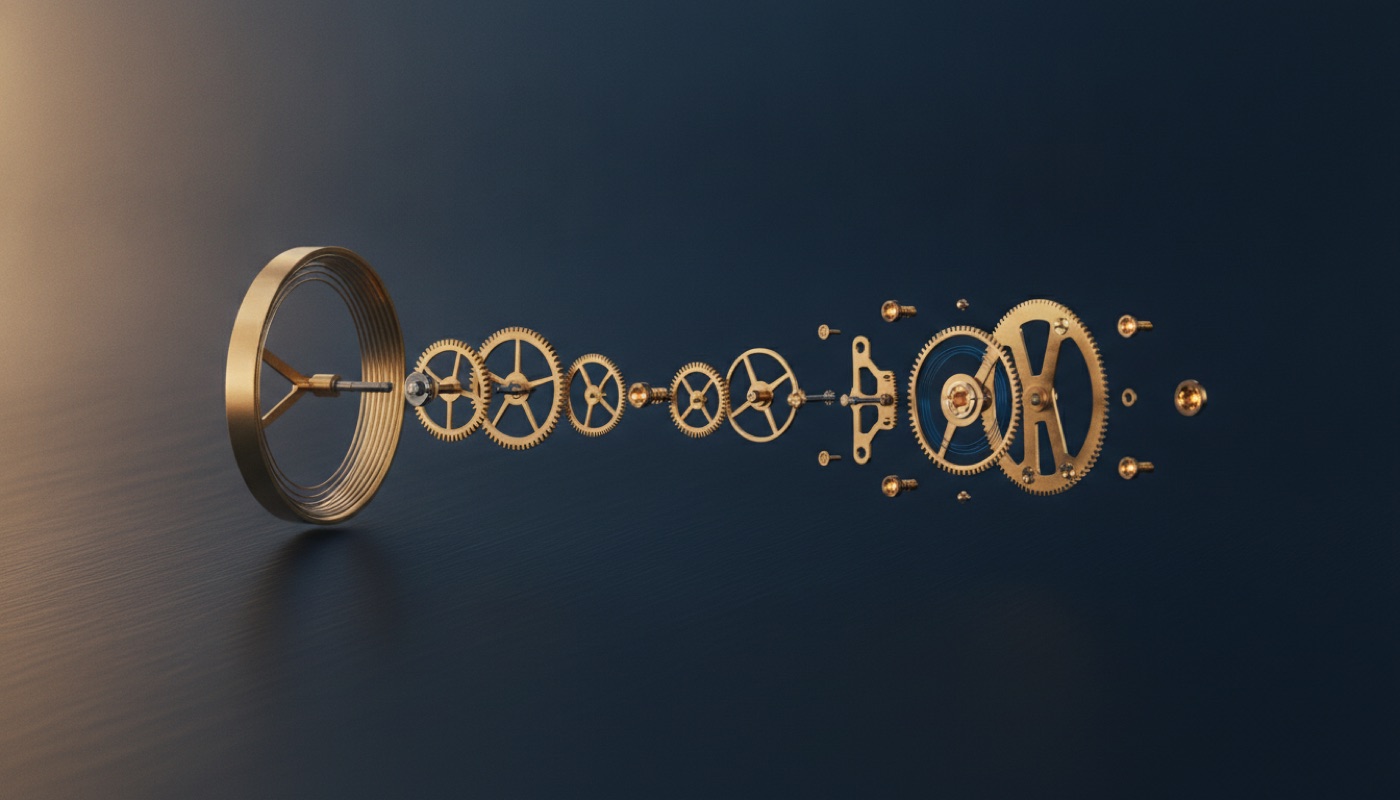
Self-winding removed the daily ritual of the crown. John Harwood patented a bumper automatic in the early 1920s, and the central rotor of 1931 perfected the idea. Owners could now wear a watch, forget it and still find it running. The layered machine behind that convenience appears in the five stages a mainspring's energy passes through.
How the tool watch escaped its profession
Around these milestones grew the culture of the tool watch. Divers got rotating bezels and thick crystals. Pilots got large crowns and slide-rule bezels. Engineers near strong magnetic fields got soft-iron shielding. Each design solved a specific job.
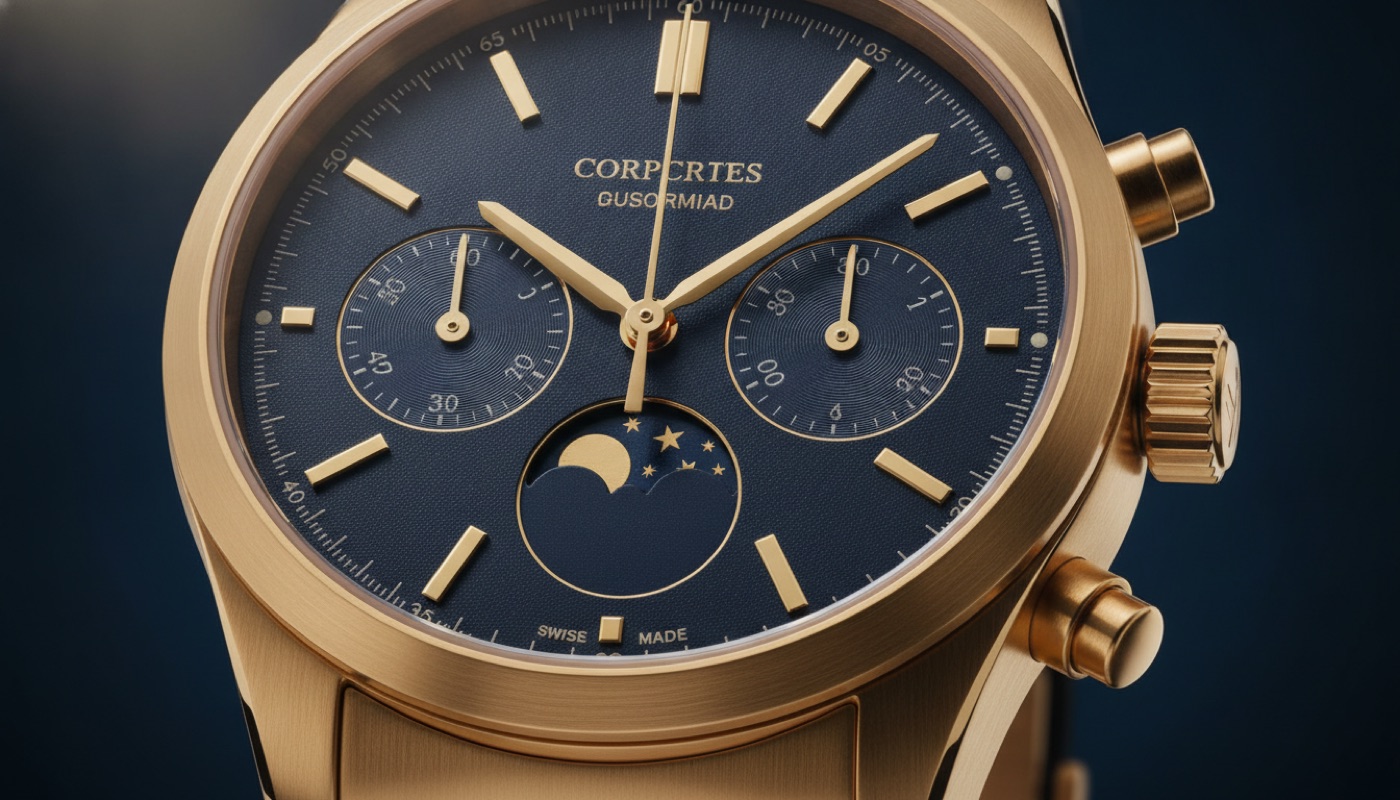
Then each escaped its profession. The dive watch became office wear, and the pilot's chronograph became a weekend watch. Most of what is now bought as style began, in these decades, as equipment. Extra functions multiplied alongside them, from dates and alarms to calendars and moon phases.
Quartz, crisis and the Swatch rescue
On 25 December 1969, Seiko put the Astron on sale in Tokyo. It was the first quartz wristwatch sold to the public, and the price was close to that of a small family car. Within ten years, mass production had made the same accuracy almost free.
Why quartz won on accuracy
A quartz watch works by a different principle. A tiny quartz oscillator, cut in a tuning-fork shape, vibrates 32,768 times a second when a current passes through it. Circuitry counts those vibrations and drives the hands or a display. A fine mechanical watch keeps time to a few seconds a day, while a quartz watch keeps it to a few seconds a month.
Digital displays followed quickly. The Hamilton Pulsar of 1972 used light-emitting diodes and a button to summon the time. Liquid-crystal displays soon replaced them, because they drew far less power. By the mid-1970s a schoolchild could own a watch more accurate than any chronometer in a museum case.
How Switzerland recovered
For Switzerland the result was the quartz crisis. Exports collapsed as production moved to Japan and Hong Kong. Long-established firms closed or merged, and Swiss watchmaking lost tens of thousands of jobs through the 1970s and early 1980s. A four-century craft was outperformed by a component costing less than a strap.
Rescue came from an unexpected direction. In 1983 the two largest Swiss groups, ASUAG and SSIH, merged under Nicolas Hayek to form the company later known as the Swatch Group. That same year they launched the Swatch: a cheap, cheerful plastic quartz watch built from 51 parts instead of the usual ninety or more. It sold in enormous numbers. Its profits helped fund the survival of the mechanical watchmaking that sat above it.
Something odder happened alongside. From the late 1980s, collectors began to prize mechanical watches precisely because they were no longer necessary. Auction prices for vintage pieces climbed, and dormant workshops reopened.
Why the mechanical watch survived the smartphone
The smartwatch re-ran the quartz story in miniature. The Apple Watch arrived in 2015, unbeatable at the wristwatch's original job and a hundred others besides. Mechanical watchmaking did not collapse a second time, because the ground had already moved. Nobody now buys a mechanical watch in order to know the time.
What they buy instead is fairly specific.
- A repairable machine. A movement made in 1960 can be serviced today, because its parts are mechanical and understood.
- Freedom from obsolescence. There is no operating system to abandon it, and no battery format to disappear.
- Visible craft. Hand finishing, jewelled bearings and a beating balance are pleasures a screen cannot copy.
- An object that outlives its owner. Watches are among the few consumer goods routinely handed down.
That shift also opened room for new makers in countries with no watchmaking tradition. Targa Watches, founded in Copenhagen in 2021, is one of them, drawing on Danish design in collections such as the DW1 and the Seal. You can see the current range on the Targa Watches page. What matters in a first purchase is weighed up in our buyer's framework for a first good watch. The wider argument about handmade things in an automated age continues in why craftsmanship still matters in the age of AI.
Tip: Buying a vintage wristwatch? Date the watch, then date its last service, and assume the gap has cost it every seal it once had. Our luxury watch care guide explains what a proper overhaul should include.
Key takeaways
- The earliest documented wristwatches were made for women, starting with Breguet's 1810 commission.
- Military need moved the watch from pocket to wrist, from the Boer War to the trenches of 1914.
- The Oyster case of 1926 and the rotor of 1931 made watches sealed and self-winding.
- Seiko's Astron of 1969 began the quartz crisis, and the Swatch of 1983 helped stabilise Switzerland.
- Mechanical watches survived the smartphone by competing on craft rather than accuracy.
Two centuries after a queen's commission, the wristwatch has outlived every confident prediction of its death. It did so by quietly changing what it is for. More of that story, from movements to makers to maintenance, is gathered under Watches & Horology.